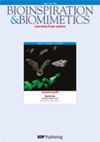
Bioinspiration & Biomimetics
SCISCIE国际简称:BIOINSPIR BIOMIM 参考译名:生物灵感与仿生学
- 基本信息:
- ISSN:1748-3182
- E-ISSN:1748-3190
- 是否OA:未开放
- 是否预警:否
- TOP期刊:否
- 出版信息:
- 出版地区:ENGLAND
- 出版商:IOP Publishing Ltd.
- 出版语言:English
- 出版周期:Quarterly
- 出版年份:2006
- 研究方向:工程技术-材料科学:生物材料
- 评价信息:
- 影响因子:3.5
- H-index:54
- CiteScore指数:5.9
- SJR指数:0.641
- SNIP指数:1.126
- 发文数据:
- Gold OA文章占比:62.99%
- 研究类文章占比:93.38%
- 年发文量:136
- 自引率:0.1470...
- 开源占比:0.1504
- 出版撤稿占比:0
- 出版国人文章占比:0.17
- OA被引用占比:0.0829...
英文简介Bioinspiration & Biomimetics期刊介绍
Bioinspiration & Biomimetics publishes research involving the study and distillation of principles and functions found in biological systems that have been developed through evolution, and application of this knowledge to produce novel and exciting basic technologies and new approaches to solving scientific problems. It provides a forum for interdisciplinary research which acts as a pipeline, facilitating the two-way flow of ideas and understanding between the extensive bodies of knowledge of the different disciplines. It has two principal aims: to draw on biology to enrich engineering and to draw from engineering to enrich biology.
The journal aims to include input from across all intersecting areas of both fields. In biology, this would include work in all fields from physiology to ecology, with either zoological or botanical focus. In engineering, this would include both design and practical application of biomimetic or bioinspired devices and systems. Typical areas of interest include:
Systems, designs and structure
Communication and navigation
Cooperative behaviour
Self-organizing biological systems
Self-healing and self-assembly
Aerial locomotion and aerospace applications of biomimetics
Biomorphic surface and subsurface systems
Marine dynamics: swimming and underwater dynamics
Applications of novel materials
Biomechanics; including movement, locomotion, fluidics
Cellular behaviour
Sensors and senses
Biomimetic or bioinformed approaches to geological exploration.
期刊简介Bioinspiration & Biomimetics期刊介绍
《Bioinspiration & Biomimetics》自2006出版以来,是一本计算机科学优秀杂志。致力于发表原创科学研究结果,并为计算机科学各个领域的原创研究提供一个展示平台,以促进计算机科学领域的的进步。该刊鼓励先进的、清晰的阐述,从广泛的视角提供当前感兴趣的研究主题的新见解,或审查多年来某个重要领域的所有重要发展。该期刊特色在于及时报道计算机科学领域的最新进展和新发现新突破等。该刊近一年未被列入预警期刊名单,目前已被权威数据库SCI、SCIE收录,得到了广泛的认可。
该期刊投稿重要关注点:
Cite Score数据(2026年6月最新版)Bioinspiration & Biomimetics Cite Score数据
- CiteScore:5.9
- SJR:0.641
- SNIP:1.126
| 学科类别 | 分区 | 排名 | 百分位 |
| 大类:Engineering 小类:Engineering (miscellaneous) | Q1 | 71 / 300 |
76% |
| 大类:Engineering 小类:Biophysics | Q2 | 45 / 155 |
71% |
| 大类:Engineering 小类:Biotechnology | Q2 | 129 / 325 |
60% |
| 大类:Engineering 小类:Biochemistry | Q2 | 182 / 448 |
59% |
| 大类:Engineering 小类:Molecular Medicine | Q2 | 84 / 179 |
53% |
CiteScore 是由Elsevier(爱思唯尔)推出的另一种评价期刊影响力的文献计量指标。反映出一家期刊近期发表论文的年篇均引用次数。CiteScore以Scopus数据库中收集的引文为基础,针对的是前四年发表的论文的引文。CiteScore的意义在于,它可以为学术界提供一种新的、更全面、更客观地评价期刊影响力的方法,而不仅仅是通过影响因子(IF)这一单一指标来评价。
中科院SCI分区Bioinspiration & Biomimetics 中科院分区
| 大类学科 | 分区 | 小类学科 | 分区 |
| 计算机科学 | 3区 | ENGINEERING, MULTIDISCIPLINARY 工程:综合 MATERIALS SCIENCE, BIOMATERIALS 材料科学:生物材料 ROBOTICS 机器人学 | 3区 4区 4区 |
| 大类学科 | 分区 | 小类学科 | 分区 |
| 计算机科学 | 3区 | ENGINEERING, MULTIDISCIPLINARY 工程:综合 MATERIALS SCIENCE, BIOMATERIALS 材料科学:生物材料 ROBOTICS 机器人学 | 3区 3区 4区 |
| 大类学科 | 分区 | 小类学科 | 分区 |
| 计算机科学 | 3区 | ENGINEERING, MULTIDISCIPLINARY 工程:综合 MATERIALS SCIENCE, BIOMATERIALS 材料科学:生物材料 ROBOTICS 机器人学 | 3区 3区 3区 |
| 大类学科 | 分区 | 小类学科 | 分区 |
| 计算机科学 | 3区 | ENGINEERING, MULTIDISCIPLINARY 工程:综合 MATERIALS SCIENCE, BIOMATERIALS 材料科学:生物材料 ROBOTICS 机器人学 | 3区 3区 3区 |
| 大类学科 | 分区 | 小类学科 | 分区 |
| 计算机科学 | 2区 | ENGINEERING, MULTIDISCIPLINARY 工程:综合 MATERIALS SCIENCE, BIOMATERIALS 材料科学:生物材料 ROBOTICS 机器人学 | 3区 3区 3区 |
中科院分区表 是以客观数据为基础,运用科学计量学方法对国际、国内学术期刊依据影响力进行等级划分的期刊评价标准。它为我国科研、教育机构的管理人员、科研工作者提供了一份评价国际学术期刊影响力的参考数据,得到了全国各地高校、科研机构的广泛认可。
中科院分区表 将所有期刊按照一定指标划分为1区、2区、3区、4区四个层次,类似于“优、良、及格”等。最开始,这个分区只是为了方便图书管理及图书情报领域的研究和期刊评估。之后中科院分区逐步发展成为了一种评价学术期刊质量的重要工具。
JCR分区Bioinspiration & Biomimetics JCR分区
| 按JCI指标学科分区 | 收录子集 | 分区 | 排名 | 百分位 |
| 学科:ENGINEERING, MULTIDISCIPLINARY | SCIE | Q1 | 43 / 178 |
76.1 |
| 学科:MATERIALS SCIENCE, BIOMATERIALS | SCIE | Q3 | 35 / 58 |
40.5 |
| 学科:ROBOTICS | SCIE | Q2 | 23 / 48 |
53.1 |
| 学科:ENGINEERING, MULTIDISCIPLINARY | SCIE | Q2 | 58 / 179 |
67.88 |
| 学科:MATERIALS SCIENCE, BIOMATERIALS | SCIE | Q3 | 32 / 58 |
45.69 |
| 学科:ROBOTICS | SCIE | Q3 | 25 / 48 |
48.96 |
| 按JCI指标学科分区 | 收录子集 | 分区 | 排名 | 百分位 |
| 学科:ENGINEERING, MULTIDISCIPLINARY | SCIE | Q1 | 41 / 179 |
77.4 |
| 学科:MATERIALS SCIENCE, BIOMATERIALS | SCIE | Q3 | 39 / 55 |
30 |
| 学科:ROBOTICS | SCIE | Q2 | 24 / 48 |
51 |
| 学科:ENGINEERING, MULTIDISCIPLINARY | SCIE | Q2 | 51 / 179 |
71.79 |
| 学科:MATERIALS SCIENCE, BIOMATERIALS | SCIE | Q2 | 25 / 55 |
55.45 |
| 学科:ROBOTICS | SCIE | Q2 | 22 / 48 |
55.21 |
| 按JCI指标学科分区 | 收录子集 | 分区 | 排名 | 百分位 |
| 学科:ENGINEERING, MULTIDISCIPLINARY | SCIE | Q1 | 37 / 179 |
79.6 |
| 学科:MATERIALS SCIENCE, BIOMATERIALS | SCIE | Q3 | 36 / 53 |
33 |
| 学科:ROBOTICS | SCIE | Q2 | 20 / 46 |
57.6 |
| 学科:ENGINEERING, MULTIDISCIPLINARY | SCIE | Q2 | 51 / 180 |
71.94 |
| 学科:MATERIALS SCIENCE, BIOMATERIALS | SCIE | Q2 | 24 / 53 |
55.66 |
| 学科:ROBOTICS | SCIE | Q2 | 19 / 46 |
59.78 |
JCR分区的优势在于它可以帮助读者对学术文献质量进行评估。不同学科的文章引用量可能存在较大的差异,此时单独依靠影响因子(IF)评价期刊的质量可能是存在一定问题的。因此,JCR将期刊按照学科门类和影响因子分为不同的分区,这样读者可以根据自己的研究领域和需求选择合适的期刊。
发文数据
- 国家/地区数量
- USA145
- CHINA MAINLAND75
- GERMANY (FED REP GER)38
- Japan20
- England17
- South Korea14
- Italy11
- Australia10
- France9
- Singapore9
本刊中国学者近年发表论文
-
1、A semi-active knee prosthesis based on a flexible soft bladder and an irregular four-bar linkage mechanis
Author: Lv, Xiaosen; Wang, Xianwen; Wang, Haoteng; Liu, Jianbin
Journal: BIOINSPIRATION & BIOMIMETICS. 2026; Vol. 21, Issue 2, pp. -. DOI: 10.1088/1748-3190/ae4865
-
2、A biologically inspired neural network for optic flow-based reactive navigation with dual depth encoding
Author: Li, Zipei; Yin, Lining; Cui, Lanyun; Yu, Ying; Wang, Qingyun
Journal: BIOINSPIRATION & BIOMIMETICS. 2026; Vol. 21, Issue 2, pp. -. DOI: 10.1088/1748-3190/ae4866
-
3、Design, modeling, and experimental study of variable stiffness pneumatic bio-inspired soft actuator
Author: Zhao, Wenchuan; Wu, Shijie; Zhang, Kunlin; Yu, Fengshuo
Journal: BIOINSPIRATION & BIOMIMETICS. 2026; Vol. 21, Issue 2, pp. -. DOI: 10.1088/1748-3190/ae492f
-
4、Pre-cracked sutures fractured by amplified forces: mechanism of efficient eclosion in arboreal butterflie
Author: Wu, Bentao; Liu, Xinyu; Zeng, Ti; Lian, Junkai; Jiao, Xiaolei; Wu, Jianing
Journal: BIOINSPIRATION & BIOMIMETICS. 2026; Vol. 21, Issue 2, pp. -. DOI: 10.1088/1748-3190/ae49cc
-
5、Generating coordinated bounding locomotion for a small-scale quadrupedal robot with thoracic-pelvic articulation via reinforcement learnin
Author: Wang, Ruochao; Du, Rongjie; Zhang, Weitao; Wang, Xishuo; Shi, Qing
Journal: BIOINSPIRATION & BIOMIMETICS. 2026; Vol. 21, Issue 2, pp. -. DOI: 10.1088/1748-3190/ae4931
-
6、A synergy-based lower limb exoskeleton that embodies natural human motor intelligenc
Author: Huang, Bo; Zhang, Hanwen; Sun, Bai-Yang; Chen, Wen-Bin; Xiong, Cai-Hua
Journal: BIOINSPIRATION & BIOMIMETICS. 2026; Vol. 21, Issue 2, pp. -. DOI: 10.1088/1748-3190/ae39c2
-
7、Design and control of a bioinspired underwater robot with hydrogel-based flexible pectoral fin
Author: Wang, Chao; Li, Zonggang; Wang, Yixian; Wang, Xiaolong; Kang, Huifeng
Journal: BIOINSPIRATION & BIOMIMETICS. 2026; Vol. 21, Issue 2, pp. -. DOI: 10.1088/1748-3190/ae4ce4
-
8、How fish body stiffness distribution affects swimming performance: a theoretical perspectiv
Author: Zhang, Xiaobo; Pei, Zhongcai; Tang, Zhiyong
Journal: BIOINSPIRATION & BIOMIMETICS. 2026; Vol. 21, Issue 2, pp. -. DOI: 10.1088/1748-3190/ae4d94
投稿常见问题
-
请问这本期刊属于什么级别呢?可用于职称评定吗?
一般刊物只分省级、部级、核心,期刊本身是没有几类划分的,具体是几类或者几级,您可以对照单位的分类文件确认一下。Bioinspiration & Biomimetics杂志是由IOP Publishing Ltd.出版的一本SCI、SCIE,可用于职称评定。
-
你们能够提供哪些核心期刊的咨询服务?
大多数核心期刊我们都是可以提供咨询服务的。目前核心期刊主要分为以下几类:1.国内核心:按照权威度排序,社科类:南大核心>南大扩展>北大核心>科技核心 按照权威度排序。工科类:CSCD C库>CSCD E库(相当于CSCD扩展)>北大核心>科技核心。2.国外核心(全英文):按照权威度排序为:SSCI=SCI>EI>ISTP=CPCI。
-
想快速发表,可以加急吗?
为了确保您的职称评定顺利进行,我们建议提前半年到一年开始准备,这样能够保证有充足的时间来处理所有相关事宜。如果客户需要加急服务,我们会与杂志社进行沟通,以确定是否可以提供加急服务。请注意,如果确认可以加急,可能会收取一定的加急费用。
-
你们提供的服务可以确保稿件被发表吗?
期刊编辑会综合考虑多个因素,如发表范围、学术价值和原创性等,对稿件进行综合评估。尽管任何机构均无法保证每篇稿件都会被发表,但我们可以用专业知识和丰富经验,协助您理解并遵循期刊的发表要求,从而提高您的稿件被发表的机率。
-
请问期刊发表的费用如何?
期刊发表的费用因期刊不同而异。根据您的需求,我们会为您推荐性价比最高的期刊,并提供专业的期刊供您选择。一般来说,只要符合职称要求,大多数作者都会选择性价比最高的期刊作为意向期刊进行重点咨询。我们会为您提供详细的期刊信息和费用说明,以确保您能够做出明智的选择。
-
如果稿件被拒,未能成功发表,费用是否可以退还?
一般来说,我们推荐的期刊和您的专业方向、文章情况都是匹配的,极少出现稿件被拒的情况。如果稿件被拒,期刊编辑会提供详细的拒稿信和建议,以帮助您了解拒稿原因并改进您的稿件。关于退款政策,具体情况可能因期刊不同而异,请您咨询我们的工作人员以获取详细信息。
相关期刊推荐
-
Geographia Polonica
中科院 4区 JCR Q3
大类:社会学
-
Journal Of Failure Analysis And Prevention
中科院 4区 JCR Q2
大类:工程技术
-

Sophia-coleccion De Filosofia De La Educacion
中科院 3区 JCR Q3
大类:教育学
-

Journal Of Feminist Scholarship
中科院 3区 JCR Q4
大类:社会学
-

Nepalese Journal Of Ophthalmology
中科院 4区 JCR Q4
大类:医学
-

Geojournal
中科院 3区 JCR Q2
大类:社会学
热门期刊推荐
-
Engineering Applications Of Artificial Intelligence
中科院 1区 JCR Q1
-
Ieee Transactions On Emerging Topics In Computational Intelligence
中科院 2区 JCR Q2
-
Applied Soft Computing
中科院 2区 JCR Q1
-
Signal Image And Video Processing
中科院 4区 JCR Q3
-
Ieee Transactions On Computational Social Systems
中科院 2区 JCR Q2
-
International Journal Of Human-computer Interaction
中科院 2区 JCR Q1
-
Neurocomputing
中科院 2区 JCR Q1
-
Machine Intelligence Research
中科院 1区 JCR Q1