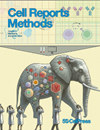
Cell Reports Methods
SCIE国际简称:CELL REP METHODS 参考译名:细胞报告方法
- 基本信息:
- ISSN:2667-2375
- 是否OA:未开放
- 是否预警:否
- TOP期刊:是
- 出版信息:
- 出版地区:United States
- 出版商:Elsevier
- 出版语言:English
- 研究方向:Multiple
- 评价信息:
- 影响因子:5.8
- CiteScore指数:7.8
- SJR指数:2.518
- SNIP指数:1.223
- 发文数据:
- Gold OA文章占比:100.00%
- 研究类文章占比:96.86%
- 年发文量:159
英文简介Cell Reports Methods期刊介绍
Cell Reports Methods is an academic journal dedicated to research methods in cell biology. This magazine is dedicated to introducing and discussing new technologies, methods, and tools in the field of cell biology, providing practical experimental guidelines and methodological references for researchers. The magazine covers various aspects such as cell culture, cell imaging, cell analysis, and cell signal transduction, introducing advanced methods and technologies in cell biology research. It not only focuses on basic research, but also on clinical applications, providing strong support for medical research.
The readers of the magazine are mainly cell biology researchers, molecular biologists, biomedical engineers, etc. This magazine provides them with the latest research methods and technological advancements, helping them better carry out their scientific research work. The magazine adopts a peer review system to ensure that the published articles are of high quality and reliability. It encourages innovation and improvement of experimental methods, promoting academic progress in the field of cell biology.
期刊简介Cell Reports Methods期刊介绍
《Cell Reports Methods》是一本生物优秀杂志。致力于发表原创科学研究结果,并为生物各个领域的原创研究提供一个展示平台,以促进生物领域的的进步。该刊鼓励先进的、清晰的阐述,从广泛的视角提供当前感兴趣的研究主题的新见解,或审查多年来某个重要领域的所有重要发展。该期刊特色在于及时报道生物领域的最新进展和新发现新突破等。该刊近一年未被列入预警期刊名单,目前已被权威数据库SCIE收录,得到了广泛的认可。
该期刊投稿重要关注点:
Cite Score数据(2026年6月最新版)Cell Reports Methods Cite Score数据
- CiteScore:7.8
- SJR:2.518
- SNIP:1.223
| 学科类别 | 分区 | 排名 | 百分位 |
| 大类:Medicine 小类:Radiology, Nuclear Medicine and Imaging | Q1 | 32 / 361 |
91% |
| 大类:Medicine 小类:Biochemistry, Genetics and Molecular Biology (miscellaneous) | Q1 | 18 / 144 |
87% |
| 大类:Medicine 小类:Genetics | Q1 | 62 / 357 |
82% |
| 大类:Medicine 小类:Computer Science Applications | Q1 | 210 / 1022 |
79% |
| 大类:Medicine 小类:Biochemistry | Q1 | 96 / 448 |
78% |
| 大类:Medicine 小类:Biotechnology | Q2 | 88 / 325 |
73% |
CiteScore 是由Elsevier(爱思唯尔)推出的另一种评价期刊影响力的文献计量指标。反映出一家期刊近期发表论文的年篇均引用次数。CiteScore以Scopus数据库中收集的引文为基础,针对的是前四年发表的论文的引文。CiteScore的意义在于,它可以为学术界提供一种新的、更全面、更客观地评价期刊影响力的方法,而不仅仅是通过影响因子(IF)这一单一指标来评价。
中科院SCI分区Cell Reports Methods 中科院分区
| 大类学科 | 分区 | 小类学科 | 分区 |
| 生物学 | 2区 | BIOCHEMICAL RESEARCH METHODS 生化研究方法 CELL BIOLOGY 细胞生物学 | 2区 3区 |
| 大类学科 | 分区 | 小类学科 | 分区 |
| 生物学 | 3区 | BIOCHEMICAL RESEARCH METHODS 生化研究方法 CELL BIOLOGY 细胞生物学 | 2区 3区 |
中科院分区表 是以客观数据为基础,运用科学计量学方法对国际、国内学术期刊依据影响力进行等级划分的期刊评价标准。它为我国科研、教育机构的管理人员、科研工作者提供了一份评价国际学术期刊影响力的参考数据,得到了全国各地高校、科研机构的广泛认可。
中科院分区表 将所有期刊按照一定指标划分为1区、2区、3区、4区四个层次,类似于“优、良、及格”等。最开始,这个分区只是为了方便图书管理及图书情报领域的研究和期刊评估。之后中科院分区逐步发展成为了一种评价学术期刊质量的重要工具。
JCR分区Cell Reports Methods JCR分区
| 按JCI指标学科分区 | 收录子集 | 分区 | 排名 | 百分位 |
| 学科:BIOCHEMICAL RESEARCH METHODS | ESCI | Q1 | 9 / 85 |
90 |
| 学科:CELL BIOLOGY | ESCI | Q2 | 64 / 207 |
69.3 |
| 学科:BIOCHEMICAL RESEARCH METHODS | ESCI | Q1 | 18 / 85 |
79.41 |
| 学科:CELL BIOLOGY | ESCI | Q2 | 59 / 207 |
71.74 |
| 按JCI指标学科分区 | 收录子集 | 分区 | 排名 | 百分位 |
| 学科:BIOCHEMICAL RESEARCH METHODS | ESCI | Q1 | 12 / 85 |
86.5 |
| 学科:CELL BIOLOGY | ESCI | Q2 | 81 / 205 |
60.7 |
| 学科:BIOCHEMICAL RESEARCH METHODS | ESCI | Q2 | 31 / 85 |
64.12 |
| 学科:CELL BIOLOGY | ESCI | Q2 | 86 / 205 |
58.29 |
JCR分区的优势在于它可以帮助读者对学术文献质量进行评估。不同学科的文章引用量可能存在较大的差异,此时单独依靠影响因子(IF)评价期刊的质量可能是存在一定问题的。因此,JCR将期刊按照学科门类和影响因子分为不同的分区,这样读者可以根据自己的研究领域和需求选择合适的期刊。
本刊中国学者近年发表论文
-
1、A streamlined, nanopore-compatible 5PSeq protocol for rapid phenotypic antimicrobial sensitivity testin
Author: Liu, Honglian; Huch, Susanne; Hull, Ryan; Garcia, Fabricio Romero; Nersisyan, Lilit; Yin, Xiushan; Chen, Wei-Hua; Du, Juan; Pelechano, Vicent
Journal: CELL REPORTS METHODS. 2026; Vol. 6, Issue 3, pp. -. DOI: 10.1016/j.crmeth.2026.101327
-
2、Interpretable learning of temporal cellular dynamics from single-cell dat
Author: Boudjelthia, Idris Kouadri; Milite, Salvatore; El Kazwini, Nour; Huang, Yuanhua; Sottoriva, Andrea; Sanguinetti, Guido
Journal: CELL REPORTS METHODS. 2026; Vol. 6, Issue 3, pp. -. DOI: 10.1016/j.crmeth.2026.101342
-
3、Application of spectral flow cytometry for comprehensive detection of immune metabolism in patient-derived microsample
Author: Bai, Yang; Wang, Yuqing; Fu, Yicheng; Guo, Zhengyang; Liang, Zhaoyuan; Yang, Liu; Ribaudo, Jiawei; Liu, Dan; Li, Yanfang; Zhang, Ting; Xue, Lixiang; Yang, Jianling; Liu, Huilin; Li, Xianlong; Zhang, Jie
Journal: CELL REPORTS METHODS. 2026; Vol. 6, Issue 3, pp. -. DOI: 10.1016/j.crmeth.2026.101330
-
4、An orthogonal CRISPR/Cpf1 platform for precise spatiotemporal gene regulation and osteoporotic fracture repai
Author: Zhao, Jie; Wang, Zengliang; Lu, Lina; Bu, Guoyun; Miao, Zukang; Zhang, Yang; Guo, Yue; Yang, Zhao; Ma, Jianxiong; Jiao, Jun; Ma, Xinlong
Journal: CELL REPORTS METHODS. 2026; Vol. 6, Issue 2, pp. -. DOI: 10.1016/j.crmeth.2025.101299
-
5、A unified framework combining linear and 3D molecular features for robust drug-protein interaction predictio
Author: Sun, Chang; Qin, Zichen; Li, Minglei; Li, Yanfei; Tang, Rong; Chen, Shengquan; Wang, Yuxiang; Liu, Yanqiang; Wei, Jinmao; Liu, Jian
Journal: CELL REPORTS METHODS. 2026; Vol. 6, Issue 2, pp. -. DOI: 10.1016/j.crmeth.2026.101304
-
6、Efficient global accuracy estimation for protein complex structural models using multi-view representation learnin
Author: Liu, Dong; Zhao, Xuanfeng; Zhang, Tianyou; Xie, Lei; Ye, Enjia; Liang, Fang; Wang, Haodong; Zhang, Guijun
Journal: CELL REPORTS METHODS. 2026; Vol. 6, Issue 2, pp. -. DOI: 10.1016/j.crmeth.2026.101312
-
7、A signature-protein-based approach for accurate and efficient profiling of the human gut virom
Author: Yang, Fangming; Xiong, Liwen; Li, Min; Feng, Xuyang; Ren, Huahui; Shi, Zhun; Zhong, Huanzi; Li, Junhua
Journal: CELL REPORTS METHODS. 2026; Vol. 6, Issue 1, pp. -. DOI: 10.1016/j.crmeth.2025.101250
-
8、Generation of thymus-reconstituting T cell progenitors from human pluripotent stem cell
Author: Philonenko, Elena S.; Zhang, Baoyun; Albert, Eugene; Shah, Zahir; Maksimov, Denis; Shu, Yahai; Li, Peng; Volchkov, Pavel; Samokhvalov, Igor M
Journal: CELL REPORTS METHODS. 2026; Vol. 6, Issue 1, pp. -. DOI: 10.1016/j.crmeth.2025.101272
投稿常见问题
-
请问这本期刊属于什么级别呢?可用于职称评定吗?
一般刊物只分省级、部级、核心,期刊本身是没有几类划分的,具体是几类或者几级,您可以对照单位的分类文件确认一下。Cell Reports Methods杂志是由Elsevier出版的一本SCIE,可用于职称评定。
-
你们能够提供哪些核心期刊的咨询服务?
大多数核心期刊我们都是可以提供咨询服务的。目前核心期刊主要分为以下几类:1.国内核心:按照权威度排序,社科类:南大核心>南大扩展>北大核心>科技核心 按照权威度排序。工科类:CSCD C库>CSCD E库(相当于CSCD扩展)>北大核心>科技核心。2.国外核心(全英文):按照权威度排序为:SSCI=SCI>EI>ISTP=CPCI。
-
想快速发表,可以加急吗?
为了确保您的职称评定顺利进行,我们建议提前半年到一年开始准备,这样能够保证有充足的时间来处理所有相关事宜。如果客户需要加急服务,我们会与杂志社进行沟通,以确定是否可以提供加急服务。请注意,如果确认可以加急,可能会收取一定的加急费用。
-
你们提供的服务可以确保稿件被发表吗?
期刊编辑会综合考虑多个因素,如发表范围、学术价值和原创性等,对稿件进行综合评估。尽管任何机构均无法保证每篇稿件都会被发表,但我们可以用专业知识和丰富经验,协助您理解并遵循期刊的发表要求,从而提高您的稿件被发表的机率。
-
请问期刊发表的费用如何?
期刊发表的费用因期刊不同而异。根据您的需求,我们会为您推荐性价比最高的期刊,并提供专业的期刊供您选择。一般来说,只要符合职称要求,大多数作者都会选择性价比最高的期刊作为意向期刊进行重点咨询。我们会为您提供详细的期刊信息和费用说明,以确保您能够做出明智的选择。
-
如果稿件被拒,未能成功发表,费用是否可以退还?
一般来说,我们推荐的期刊和您的专业方向、文章情况都是匹配的,极少出现稿件被拒的情况。如果稿件被拒,期刊编辑会提供详细的拒稿信和建议,以帮助您了解拒稿原因并改进您的稿件。关于退款政策,具体情况可能因期刊不同而异,请您咨询我们的工作人员以获取详细信息。
相关期刊推荐

热门期刊推荐
-
Acs Chemical Biology
中科院 2区 JCR Q2
-
Communications Biology
中科院 1区 JCR Q1
-
Computational And Structural Biotechnology Journal
中科院 2区 JCR Q2
-
Briefings In Bioinformatics
中科院 2区 JCR Q1
-
Microbiological Research
中科院 1区 JCR Q1
-
Faseb Journal
中科院 2区 JCR Q1
-
International Journal Of Biological Macromolecules
中科院 2区 JCR Q1
-
Peerj
中科院 3区 JCR Q2